
Engineering case study
Speech-to-Action OS Assistant
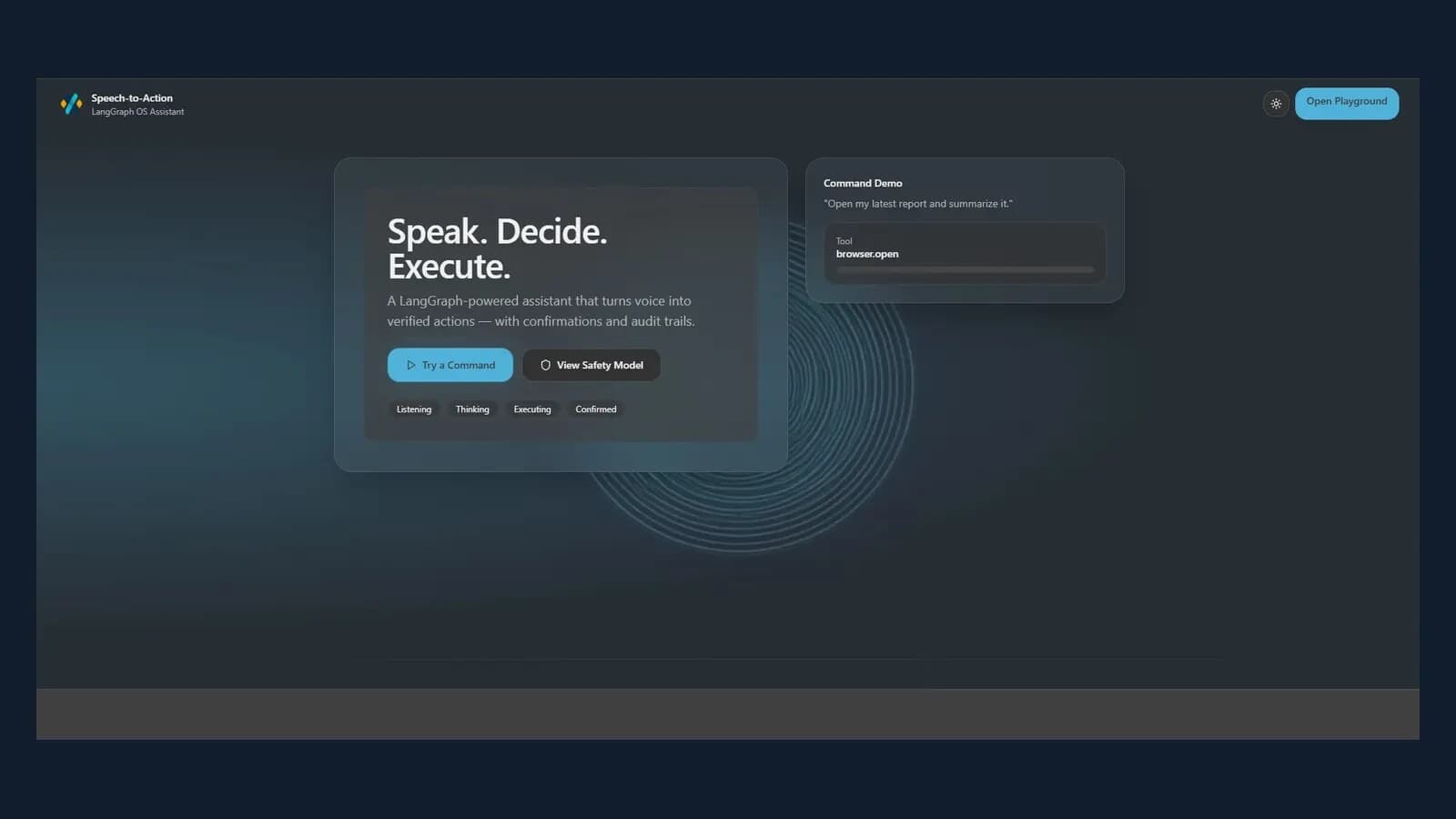
A voice- and text-driven agent that turns natural-language requests into planned, confirmed and observable browser actions.
01 / EVIDENCE
The problem
Natural-language commands are convenient, but immediate execution can hide ambiguity, remove user control and make mistakes difficult to reconstruct.
02 / EVIDENCE
The control model
LangGraph separates intent understanding, planning, risk checks, confirmation and execution into explicit states.
- Voice and text input
- Visible proposed action plan
- Human confirmation before action
- Allowlisted tool boundaries
- Real-time status and audit trail
- Failure recovery and cancellation
03 / EVIDENCE
Key engineering decisions
Approval is part of the workflow architecture, not a dialog added after autonomous behavior has already been designed.
04 / EVIDENCE
What this demonstrates
Controlled agent orchestration, safe tool use, observability and human-in-the-loop product design—not unsupervised high-impact automation.
Next step
Discuss a similar challenge.
Start with the business context, desired outcome and current constraints. We will establish whether Norrelium is a sensible fit.